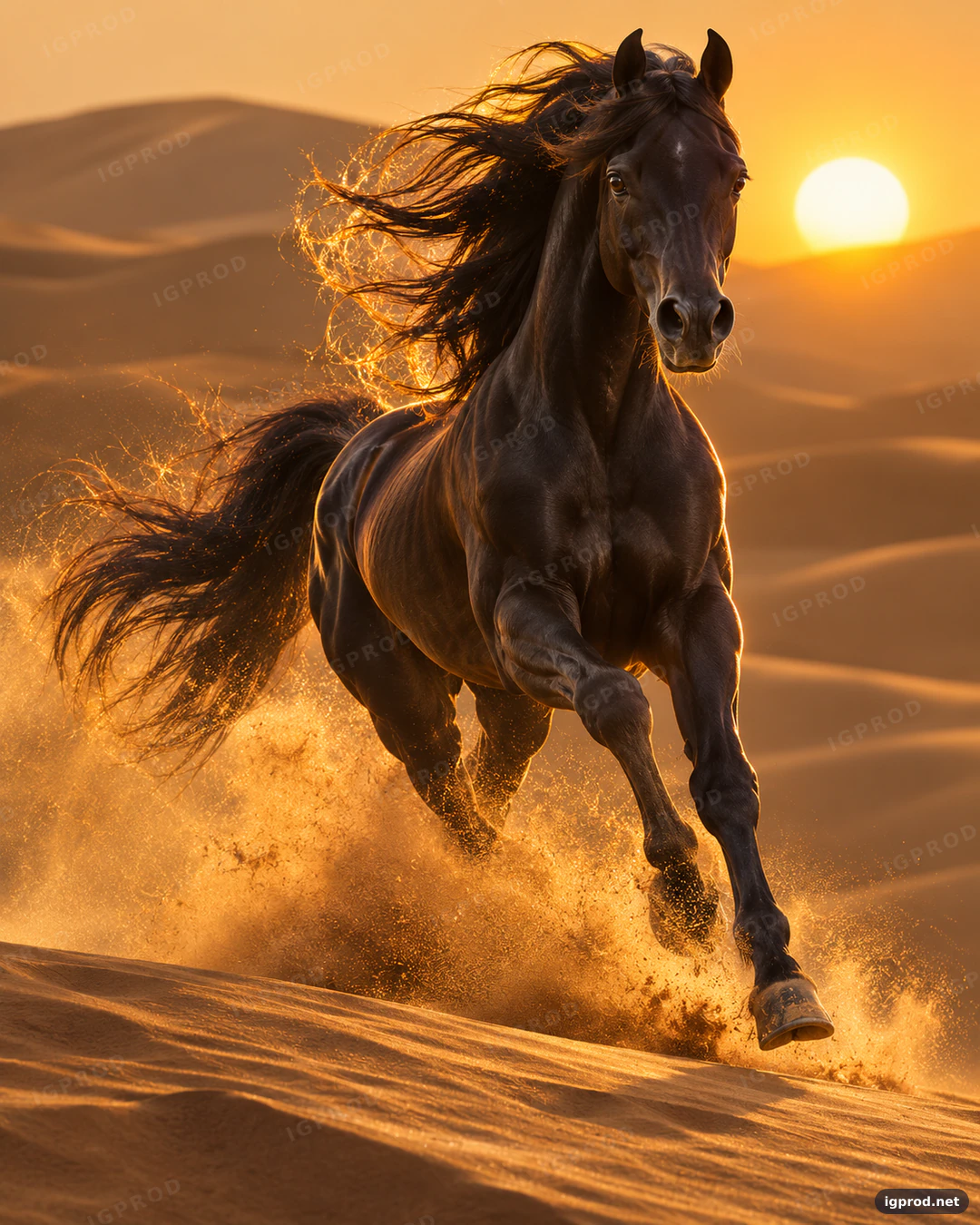
This horse prompt makes a cinematic wildlife photograph: a black Arabian stallion galloping on a Sahara dune at golden hour, its mane and tail lit like fire and sand bursting from its hooves. There is no text and no product. It is written like a photographer's shot list, with the lens, the shutter speed and the light named one by one. We ran it once in OpenAI's image model; the image below is that first result, unedited apart from the IGPROD watermark.
What the image shows
OpenAI's image model returned one portrait image of 1122 × 1402 pixels, which is a 4:5 frame. A dark Arabian stallion gallops toward the camera at a slight angle, with its head up, ears forward, eyes bright and nostrils open. Its long mane and tail stream back to the left and glow gold where the backlight passes through the hair.
Sand explodes from under the hooves and hangs in the air in a golden cloud. The sun sits low on the right above rolling dunes that fade into a warm haze, and the whole frame is graded in amber and gold. The head and the eye are sharp, and the dunes behind are soft. There is no rider, saddle, bridle, text or second horse, and the four legs and hooves are drawn correctly.
Three details differ from the prompt. The coat came out a very dark brown with warm highlights rather than a pure black, because the strong golden light colors everything it touches. The front hoof closest to the camera wears a metal horseshoe, a sign of a domestic horse that the prompt never asked for. And the horse runs down the slope of the dune more than along its crest.
Why this horse prompt works
Breed and color first. "One black Arabian stallion with a long flowing mane and tail" gives the model a breed with a well-known shape: the fine head, the arched neck and the high tail. "One" keeps a herd out of the frame.
A pose with a direction. "Galloping toward the camera at a slight angle" is more dramatic than a side view, and "front legs reaching forward" picks the exact moment of the stride.
Motion you can see. Sand bursting from the hooves and a mane and tail streaming in the wind show speed in a still image, without the motion blur that would soften the horse.
Backlight, the secret of golden hour. The sun behind the horse draws a bright rim around the body and lights every strand of the mane. Bounce light from the dunes keeps the chest and the face from turning into a black shape.
Lens and shutter as instructions. A 400 mm lens at f/4 squeezes the dunes behind the horse and blurs them, and 1/2000 s freezes the grains of sand. These are the settings wildlife photographers use, and the model knows the look they produce.
Color control. "Warm amber and gold tones" and "deep shadows" set the grade. "True black coat with no color cast" asks the model to keep the horse dark; as the result shows, warm light still tints it.
An Avoid line for horse anatomy. Extra or deformed legs and hooves are the classic failure of AI horses, and riders or tack would change the story, so the prompt rules them out at the end.
The horse prompt, ready to copy
Create a cinematic wildlife photograph of a horse, vertical 4:5 (1080x1350).
Subject: one black Arabian stallion with a long flowing mane and tail, galloping toward the camera at a slight angle along the crest of a golden sand dune, front legs reaching forward, nostrils flared, muscles clearly defined.
Action: fine sand bursts from the hooves and hangs in the air behind the horse; the mane and tail stream in the wind.
Scene: the Sahara desert at golden hour, rolling dunes in long soft waves, a low sun behind the horse on the right.
Lighting: strong golden backlight that outlines the horse with a bright rim, warm sunlight glowing through the flying sand, soft bounce light from the dunes on the chest and face.
Camera: 400 mm telephoto lens at f/4 from a low angle, shutter 1/2000 s, the eye and head tack-sharp, the dunes behind softly compressed.
Color: warm amber and gold tones, deep shadows, rich contrast, true black coat with no color cast.
Style: award-winning equine and wildlife photography, ultra-detailed, photorealistic.
Avoid: riders, saddles, bridles, people, buildings, vehicles, extra horses, extra or deformed legs and hooves, text.
Paste it as it is into ChatGPT's image generation or another image model. To make it yours, change the breed, the coat and the place first, then the light. If you call OpenAI's model through its API, the image generation guide lists the sizes and quality options it accepts.
Three ways to change the horse photo
- A gray horse in the snow: change the Subject to "one dapple gray Arabian stallion", the Scene to "a snowy mountain meadow at sunrise" and the Color line to "cool blue and soft pink tones". Keep the lens and the shutter speed.
- A calm portrait: replace the pose with "standing still on the crest of a dune in side view, head turned toward the camera, the wind lifting the mane". It suits a wallpaper or a print better than a gallop.
- Blue hour: change the light to "the last blue light after sunset, a thin orange line on the horizon, a soft rim of sky light on the horse" and the Color line to "deep blue and copper".
Check the result before you use it
- Count the legs. Four legs, one hoof each, and every joint bending the right way: this is where AI horses fail most often.
- Look at the head. The eye should be clear and sharp, the ears pointing forward together, the nostrils open but not stretched.
- Follow the wind. The mane, the tail and the flying sand should all move in the same direction.
- Check for tack and shoes. For a free horse, add "unshod hooves" to the Subject line and make sure no bridle or halter appears.
Frequently asked questions
Does this prompt work in Gemini (Nano Banana)?
The prompt is plain text, so you can paste it into Gemini's image model too. We ran it only in OpenAI's model, so expect a different horse, pose and light there.
Why does this prompt have no text?
It describes a photograph, not a poster. Asking for a title pulls the model toward a layout with free space and graphics. If you need a title, add a Typography line and leave room for it in the sky.
Can I use the image as a phone wallpaper?
Change "vertical 4:5 (1080x1350)" to "vertical 9:16" in the first line so the dunes and the sky fill a phone screen. For any commercial use, read the terms of the image tool you use first.
More image prompts
For another wildlife photo, see the river otter image prompt, and for a night scene with rain and city lights, the cinematic car prompt. Every prompt we tested is in IGPROD image prompts.

Leave a comment
Your email address will not be published. Required fields are marked *