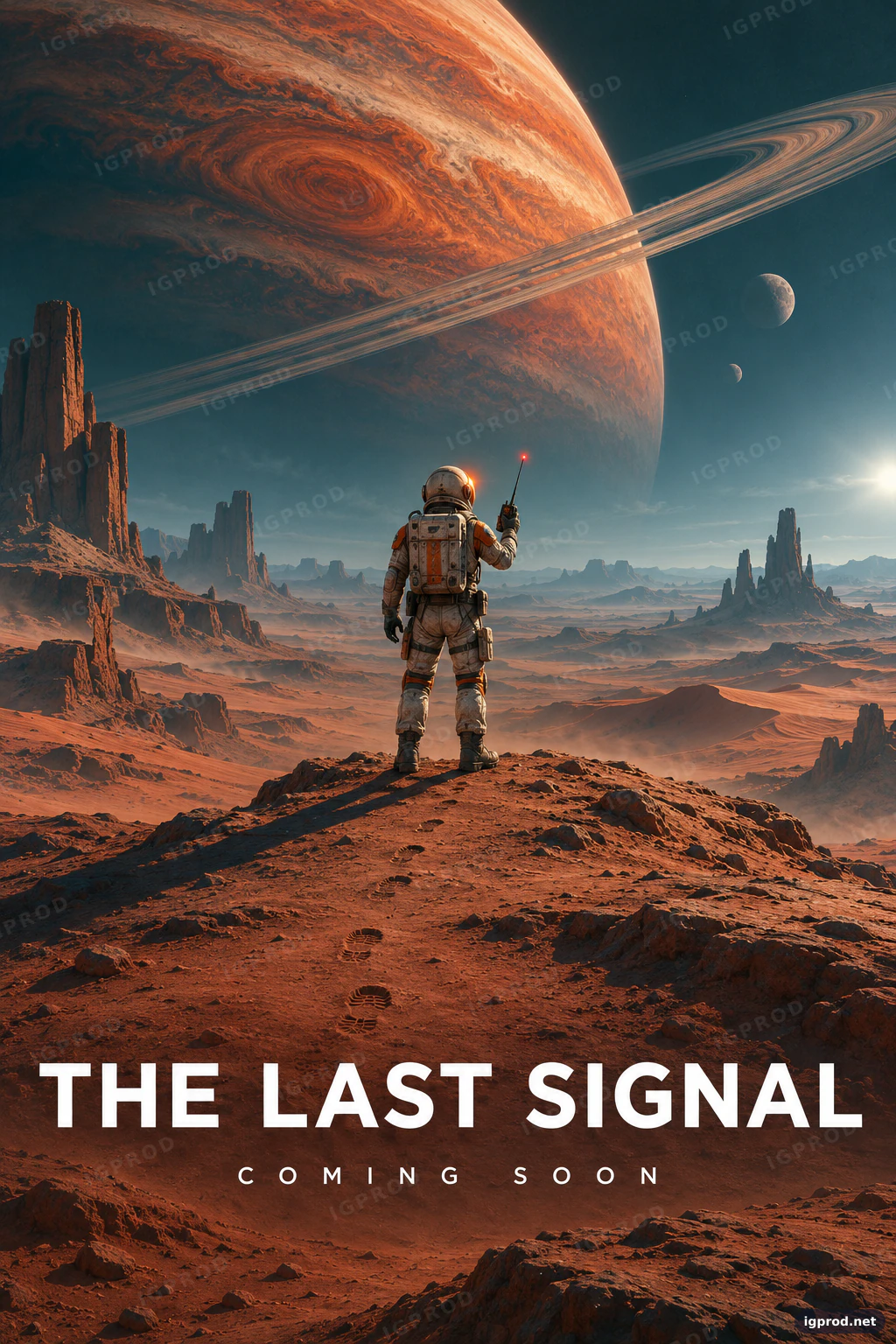
This movie poster prompt describes the key art for a science-fiction film that does not exist: a lone astronaut on a ridge of red rock, a giant ringed planet filling the sky, and the title "THE LAST SIGNAL" set in clean white capitals. It is written the way a poster designer briefs an artist, with a separate line for the lettering. We ran it once in OpenAI's image model; the image below is that first result, unedited apart from the IGPROD watermark.
What the image shows
OpenAI's image model returned one portrait image of 1024 × 1536 pixels, which is the 2:3 frame of a cinema one-sheet. An astronaut in a worn white spacesuit with orange panels stands on a rocky ridge with his back to us. He holds up a handheld radio with a thin antenna and a small red light at its tip, and a life-support pack covers his back.
A huge planet with orange and cream bands and a swirling storm fills the upper half of the sky, and a pale ring cuts across it. Two small moons hang on the right, and the sun sits low on the right horizon. Around the ridge, a rust-red desert of wind-carved rock towers and dunes runs to the horizon in a light haze, and a trail of boot prints leads from the bottom of the frame up to the astronaut.
The title reads "THE LAST SIGNAL" in bold white capitals across the lower third, and "COMING SOON" sits under it in small, widely spaced letters. Both are spelled correctly and there is no other text. One detail differs from the prompt: the astronaut is medium-sized in the frame rather than small, so the planet feels a little less overwhelming than the brief intended.
Why this movie poster prompt works
A frame from the real world. "Cinematic movie poster, vertical 2:3" matches the shape of real film posters, so the model composes for a tall print with room for a title.
A hero seen from behind. An astronaut with his back to us is a classic poster device: the viewer stands where he stands and looks at what he sees. It also avoids faces, which keeps the image clear of any real actor.
A story in one prop. The radio with a blinking red light answers the title. Without saying a word, the poster tells you someone is calling for help, or listening for an answer.
Scale from the background. A giant ringed planet, two small moons and rock towers that shrink into haze give the scene its size. The footprints add time: he has walked a long way to reach this ridge.
A Typography line with the exact words. The title and the tagline are quoted exactly, with their size, color and position, and "No other text" closes the line. That is why the model spelled both correctly and added no fake credits.
Film words for the look. "Key art", "anamorphic widescreen lens look", "subtle film grain" and "teal and orange color grade" are the language of film marketing. They give the picture its cinema feel without naming any studio or film.
The movie poster prompt, ready to copy
Create a cinematic movie poster, vertical 2:3 (1024x1536).
Subject: a lone astronaut in a weathered white and orange spacesuit, seen from behind and small in the frame, standing on a ridge of red desert rock and holding up a handheld radio antenna with a small blinking red light.
Background: a vast rust-red alien desert of wind-carved rock towers and dunes, a giant ringed planet filling the upper half of the sky, two small moons, a thin trail of footprints in the dust behind the astronaut.
Lighting: low cold-white sunlight from the right, long blue shadows, a warm orange rim light from the planet's glow on the helmet and the rocks, faint haze in the distance for depth.
Typography: the title "THE LAST SIGNAL" in large clean bold white capital letters across the lower third, and under it "COMING SOON" in small, widely spaced capitals. No other text.
Camera: anamorphic widescreen lens look, low angle, subtle film grain.
Style: premium science-fiction film key art, photoreal, teal and orange color grade, strong central composition with empty space for the title.
Avoid: women or girls, weapons, real actors, film studio logos, extra limbs, distorted or misspelled letters, religious symbols.
Paste it as it is into ChatGPT's image generation or another image model, then change the title in the Typography line to your own. Keep titles short: two to four words come out cleaner than a long sentence. If you call OpenAI's model through its API, the image generation guide lists the sizes and quality options it accepts.
Three ways to change the movie poster
- An ocean planet: replace the desert with "an endless ocean with tall waves and floating ice, the astronaut on a small rocky island" and change the color grade to "cold blue and silver".
- A thriller look: change the setting to "a rainy neon city at night, the hero in a long coat under a streetlight", the title to "NIGHT SHIFT" and the grade to "deep blue and red".
- A teaser poster: keep only the planet and the title, add "minimal teaser poster, the astronaut tiny at the bottom" and "a release date line: NOVEMBER 2027".
Lettering tips for AI posters
Image models now write short titles well when the prompt quotes them exactly. Put every word you want in quotation marks, say where it goes and how big it is, and end the line with "No other text", or the model may invent credits, studio names or a rating box.
For a print, leave the title area simple. A plain stretch of ground or sky behind the letters keeps them readable, which is why the brief asks for "empty space for the title". If you need perfect lettering, generate the image without text and add the title in a design tool afterwards.
Check the result before you use it
- Read every letter. Check the spelling of the title and the tagline one letter at a time, and check the spacing between words.
- Look at the hands and the gear. Count the fingers on the gloves and make sure the radio and the backpack are attached to the suit.
- Search for hidden logos. Suit patches and equipment can turn into fake logos. Remove them or add "no patches, no logos" to the Avoid line.
- Do not copy real films. If the title or the scene looks like a real film, change it: a fan poster that copies a real one can break someone's rights.
Frequently asked questions
Can the model write the movie title correctly?
In this run it did, because the title was short, quoted exactly and set in plain capitals. Long titles, unusual fonts and small credit blocks still fail more often, so check every letter.
How do I turn it into a 16:9 banner?
Change the first line to "cinematic banner, horizontal 16:9 (1920x1080)" and move the title to the left third. Keep the planet on the right so the two do not overlap.
Does this prompt work in Gemini (Nano Banana)?
The prompt is plain text, so you can paste it into Gemini's image model too. We ran it only in OpenAI's model, so the astronaut, the planet and the lettering will look different there.
More image prompts
For another poster built around a hero subject, see the cinematic car prompt for a hypercar poster and the lime sports car advertising poster prompt. Every prompt we tested is in IGPROD image prompts.
Leave a comment
Your email address will not be published. Required fields are marked *